A tooth that hurts when you bite, reacts strongly to hot or cold, or starts aching without an obvious reason may have a problem deeper than a simple cavity.
Sometimes the dental pulp—the living tissue inside a tooth—becomes irreversibly inflamed or infected. When this happens, root canal treatment (RCT) may be recommended to remove the diseased tissue, control infection and preserve the natural tooth.
Endodontics has evolved significantly. Modern root canal treatment combines accurate diagnosis with electronic working-length determination, contemporary instrumentation, irrigation and disinfection, magnification, digital imaging and improved restorative techniques.
But technology is only one part of successful treatment.
The goal is to diagnose the problem correctly, control infection and preserve the natural tooth whenever its long-term prognosis is favourable.
What Is Root Canal Treatment?
The centre of a tooth contains a soft tissue called the dental pulp, which contains nerves and blood vessels.
Deep dental decay, cracks, trauma or repeated dental procedures can damage the pulp. If inflammation becomes irreversible or the pulp becomes infected, root canal treatment may be necessary.
During an RCT, the dentist:
- 1 Creates access to the root canal system.
- 2 Removes diseased or infected pulp tissue.
- 3 Cleans and shapes the canals.
- 4 Disinfects the canal system.
- 5 Fills and seals the canals.
- 6 Restores the tooth appropriately.
The objective is not simply to "remove the nerve."
The objective is to control infection and inflammation while retaining a functional natural tooth whenever possible.
When Do You Need a Root Canal?
Not every toothache requires a root canal.
A root canal may be recommended when examination and testing indicate irreversible pulpal inflammation, pulp necrosis or associated periapical disease.
Possible warning signs include:
- Persistent toothache
- Spontaneous tooth pain
- Pain while biting or chewing
- Prolonged sensitivity to hot or cold
- Night-time toothache
- Swelling around the tooth
- A recurring gum boil or sinus tract
- Tenderness around the root
- Tooth discolouration following trauma
- Deep dental decay
- Symptoms in a previously root-canal-treated tooth
However, symptoms alone do not establish the diagnosis.
Some teeth with pulpal or periapical disease may have very few symptoms. This is why an endodontic evaluation may include clinical examination, pulp testing and appropriate dental imaging before treatment is recommended.
Does Root Canal Treatment Hurt?
This is one of the most common concerns patients have.
With appropriate local anaesthesia and modern clinical techniques, root canal treatment is generally performed comfortably.
Some tenderness can occur after treatment, particularly when there was significant inflammation or infection before the procedure.
Postoperative endodontic pain continues to be studied. A 2026 umbrella review examining evidence on instrumentation, irrigation and obturation found that postoperative pain can be influenced by multiple treatment and patient-related factors rather than one single technique.
The important point is that modern RCT is designed to treat the source of dental pain and infection, not unnecessarily create discomfort.
What Has Changed in Root Canal Treatment in 2026?
The fundamental biological principles of endodontics have not changed.
What has improved is our ability to diagnose anatomy, control treatment and manage difficult cases more precisely.
1. More Accurate Working-Length Determination
Determining the working length of each root canal is an important part of endodontic treatment.
Electronic apex locators, together with appropriate radiographic assessment, help clinicians determine working length more accurately.
Artificial intelligence is also being investigated as an additional tool.
Recent 2026 research has evaluated AI models designed to assist with working-length and apical-landmark assessment. The results are promising, but AI remains an emerging adjunct and should not be considered a replacement for established clinical methods or professional judgement.
AI may assist the clinician; it does not replace the clinician.
2. Better Understanding of Root Canal Anatomy
Root canals are often more complex than they appear on a conventional dental X-ray.
A tooth may contain:
- Additional canals
- Curvatures
- Isthmuses
- Fins
- Calcifications
- Anatomical variations
This becomes particularly important when treating molars, calcified canals and previously treated teeth.
Understanding this anatomy is one of the reasons specialist endodontic assessment can be valuable in complex cases.
CBCT and Root Canal Treatment
Cone-beam computed tomography (CBCT) provides three-dimensional information that cannot always be obtained from conventional two-dimensional dental radiographs.
CBCT may be useful in selected situations involving:
- Complex root canal anatomy
- Suspected additional canals
- Root resorption
- Suspected root fracture
- Periapical pathology
- Calcified canals
- Previous unsuccessful root canal treatment
- Endodontic treatment complications
However, CBCT is not required for every root canal treatment.
The decision should be based on the clinical situation and whether three-dimensional information is likely to influence diagnosis or treatment planning.
More imaging does not automatically mean better dentistry. The right investigation is the one that provides clinically useful information.
Irrigation and Root Canal Disinfection
Cleaning a root canal is not simply a mechanical procedure.
Root canal systems contain microscopic spaces and anatomical irregularities that instruments cannot directly contact. Mechanical preparation therefore needs to be combined with appropriate irrigation and disinfection.
Research published in 2026 continues to evaluate different irrigation protocols and activation techniques.
Recent studies have investigated whether ultrasonic and laser-activated irrigation can influence postoperative pain and other treatment outcomes. The results are interesting, but the choice of irrigation protocol should still be based on the individual clinical situation and available evidence.
Effective disinfection matters more than simply using the newest device.
What Role Does AI Have in Endodontics?
Artificial intelligence is becoming increasingly relevant to dentistry.
In endodontics, researchers are investigating AI applications including:
- Image analysis
- Identification of anatomical structures
- Working-length assessment
- CBCT interpretation
- Treatment planning
- Assessment of root-canal filling quality
The 2026 literature shows significant potential, but many applications remain under development and require further clinical validation.
For patients, AI should currently be viewed primarily as a decision-support technology, rather than an autonomous replacement for a dentist.
The future of endodontics is likely to be: experienced clinician + accurate diagnosis + appropriate technology.
Can a Root Canal Save Your Natural Tooth?
Often, yes.
One of the major advantages of endodontic treatment is that it can allow a diseased tooth to remain in the mouth rather than being extracted.
However, not every tooth is suitable for RCT.
A tooth may have a poor prognosis because of factors such as:
- Vertical root fracture
- Extensive loss of tooth structure
- Severe periodontal support loss
- Unfavourable anatomy
- Certain treatment complications
The important question is therefore not simply: "Can an RCT be done?"
It is: "Can this tooth be predictably treated and restored?" That is where accurate diagnosis and treatment planning become important.
Root Canal Treatment vs Tooth Extraction
Extraction may initially appear to be the simpler option.
But removing a tooth creates a missing-tooth problem.
Depending on the situation, the missing tooth may subsequently need to be replaced with:
- A dental implant
- A fixed bridge
- A removable prosthesis
If a natural tooth can be predictably treated and restored, preserving it may avoid the need for extraction and subsequent replacement.
However, saving a tooth at any cost is not good dentistry.
The treatment decision should consider the prognosis of the tooth, the patient's needs, available alternatives and expected long-term outcome.
What Happens After a Root Canal?
Completing the RCT is only one part of treatment.
The tooth also requires an appropriate definitive restoration.
Depending on the tooth and the amount of remaining structure, this may involve a bonded restoration, onlay or crown.
The final restoration needs to restore function and protect the remaining tooth structure.
Recent 2026 research continues to investigate different root-canal filling techniques and materials. A large systematic review and meta-analysis published in 2026 found that no single obturation technique consistently demonstrated superiority across all follow-up periods, reinforcing the importance of case selection, treatment quality and operator expertise.
There is no single material or technique that guarantees endodontic success. Successful treatment is multifactorial.
What Determines the Success of a Root Canal?
Several factors work together to influence the prognosis of an endodontically treated tooth.
Accurate Diagnosis
The underlying problem needs to be correctly identified before treatment begins.
Understanding the Anatomy
Complex anatomy needs to be identified and managed appropriately.
Effective Cleaning and Disinfection
Mechanical preparation and chemical disinfection work together to reduce microbial contamination.
Appropriate Root Canal Filling
The prepared canal system needs to be appropriately filled and sealed.
Good Coronal Restoration
The final restoration needs to protect the remaining tooth and provide an adequate seal.
Appropriate Case Selection
Not every tooth has the same prognosis.
Operator Experience
Clinical expertise becomes particularly important when managing complex anatomy, retreatment and treatment complications.
Can a Failed Root Canal Be Treated Again?
Sometimes.
A previously treated tooth can develop persistent or recurrent disease.
Possible reasons include:
- Missed canals
- Persistent infection
- Inadequate cleaning
- Leakage
- New decay
- Root fracture
- Complex anatomy
- Problems with the final restoration
Depending on the cause, treatment options may include non-surgical retreatment, endodontic surgery or extraction.
Non-surgical retreatment
The previous root filling is removed and the canal system is cleaned and treated again.
Endodontic surgery
In selected cases, surgical endodontic treatment may be considered when conventional retreatment is not appropriate or predictable.
Extraction
If the tooth cannot be predictably saved, extraction and subsequent tooth replacement may be the more appropriate option.
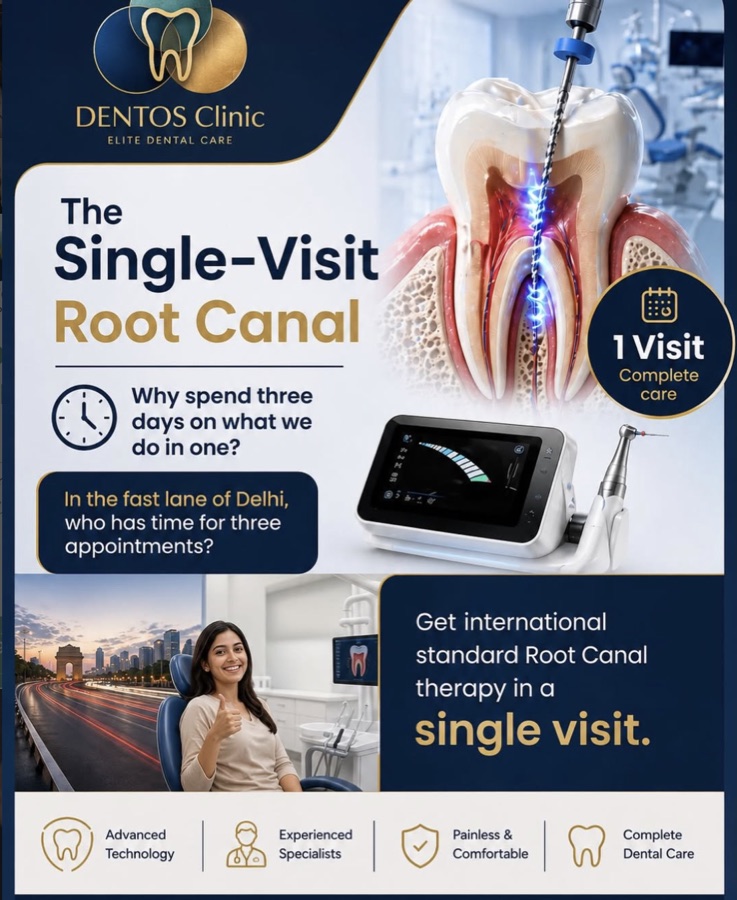
How Many Visits Does Root Canal Treatment Take?
There is no universal number of appointments.
Some cases can be completed in one visit, while others require more than one appointment.
The number of visits depends on factors such as:
- Tooth anatomy
- Number and complexity of canals
- Presence of infection
- Calcification
- Previous root canal treatment
- Treatment complications
- Individual clinical circumstances
The priority should be appropriate treatment rather than simply completing the procedure in the fewest possible appointments.
Why Consider Specialist Endodontic Care?
Endodontics is highly dependent on anatomy and diagnosis.
A straightforward front tooth and a heavily calcified molar can present very different clinical challenges.
An endodontist has advanced training focused on diseases of the dental pulp and tissues surrounding the roots.
Specialist endodontic care can be particularly valuable for:
- Complex molars
- Calcified canals
- Root canal retreatment
- Persistent periapical disease
- Endodontic emergencies
- Instrument separation
- Perforation management
- Difficult root canal anatomy
- Endodontic surgery
Root Canal Treatment at Dentos Clinic, Vasant Kunj
At Dentos Clinic, Vasant Kunj, our approach is centred on accurate diagnosis, conservative treatment planning and preservation of natural teeth whenever a predictable prognosis is possible.
Treatment is planned according to the individual tooth rather than applying exactly the same protocol to every patient.
Our approach focuses on:
Diagnosis
Understanding the cause of the problem before starting treatment.
Precision
Using appropriate technology and contemporary endodontic techniques where they provide a clinical advantage.
Conservative dentistry
Preserving healthy tooth structure whenever possible.
Patient comfort
Explaining treatment clearly and managing discomfort appropriately.
Long-term restoration
Considering the final restoration as an important part of the overall treatment.
When Should You See an Endodontist?
Consider a dental evaluation if you experience:
- Persistent toothache
- Pain while chewing
- Prolonged hot or cold sensitivity
- Swelling around a tooth
- A recurring gum boil
- Tooth discolouration following trauma
- Persistent symptoms after a previous RCT
- A tooth diagnosed with deep decay
You do not have to wait until the pain becomes severe.
Conclusion
Root canal treatment in 2026 is about much more than simply removing the nerve.
Modern endodontics combines accurate diagnosis, effective disinfection, precise treatment, conservative tooth preservation and appropriate restoration.
Technologies such as CBCT, advanced irrigation and emerging AI applications are expanding the diagnostic and treatment options available to clinicians. But technology works best when it is guided by sound biological principles and clinical experience.
If your natural tooth has a favourable prognosis, the aim should be to give that tooth the best possible chance of remaining functional and healthy for years to come.